



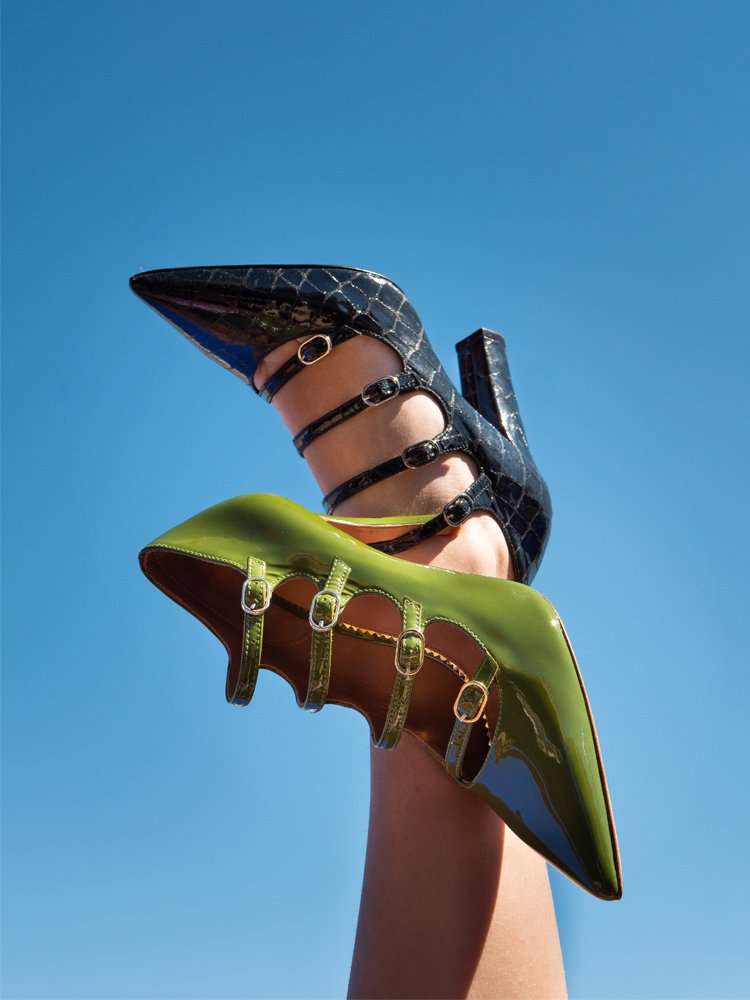

Ask any experienced shoeman, “What’s a shoe?” You’d assume he could give you the answer in detail, but a high percentage can’t get beyond a few elements. Few ever realize how complex a product a shoe actually is, its properties, its functional characteristics, etc.
A shoe contains many different materials: leather, fabrics, rubber, paper, cork, metal, plastics, natural or synthetic fibres, wood, composition materials, a host of chemicals, man-made materials, etc…. but even some of these subdivide extensively. For example, there can be a hundred different kinds of leather, and the same array of fabrics or man-made materials. If each basic material included all variations or subdivisions, then the “materials” list alone would stretch to a thousand or even more.
A shoe isn’t a unit but an assembly of components combined to create a unit (heel, outsole, insole, fillers, counter box, toe box, welt, quarter, sock and vamp lining, shank, tongue, thread, ornaments, fittings, etc… perhaps 20 or more and again, if subdivided by types, grades, sizes, widths, etc. you’d be into the many scores. A shoe isn’t merely “made”, I’d say that is “constructed”. And even we’re not speaking about the different constructions as good-year, welt, strobbel, cold cement, vulcanize, etc… There is really no such thing as a “shoe” in a generic sense. There are only types of footwear as a boot, oxford, sandal, sneaker, slipper, pump, d’Orsays, clog, platform, running, walking, safety, athletic, hiking, etc… how many types? Scores and scores. Each “shoe” has its own personality, its own end-use purpose that isolates it as a product onto itself, unlike others.
If you put together the possible combinations of materials, components, constructions, sizes, shapes, widths and type of footwear, it would probably be easier to count the number of stars in the heaven. But a shoe is hardly a static product. It must also fulfill numerous complex functional purposes. And it must please the eye and senses as well as serve the foot. A shoe must fit properly (a task of ingenious engineering when you consider that a given shoe has only one size and shape, while a given foot has many different sizes and shapes under various functional conditions). The consumer doesn’t know this and hence takes “proper fit” for granted.
The shoe is expected to give the foot the same comfort as comfortable bed gives to the body. In addition, the shoe bears responsibility for keeping the foot healthy and free of ills, despite the combination of abuse and neglect given to the shoes and feet of the average person. But the responsibilities of the shoe still aren’t completed. The shoe must please the eye and senses of every woman. It must be an object of beauty in design, shape, colour, softness, ornamentation, texture, etc… It must delight the aesthetic senses. And also, it must have a quality of status, an object of pride both to wear and see.
If a shoe could speak, perhaps its first words to shoeman and consumers alike would be: “Please, never take me for granted. You ask so many different things of me and I give so much of myself to serve you long and well. All I ask in return is a little appreciation for what I am and what I do for you”.